Eustace Cox
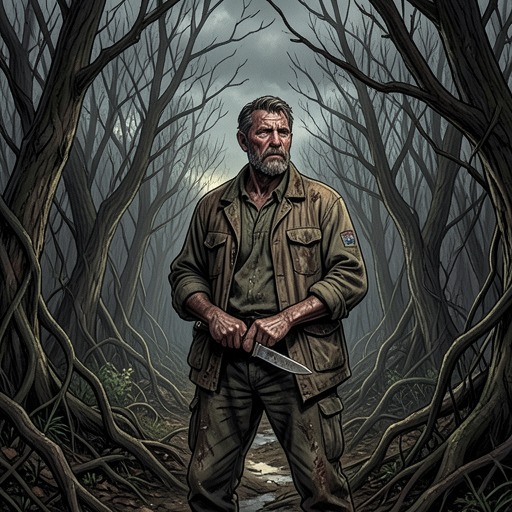
The ThicketEustace Cox is a tracker whose knowledge of land, bodies, and violence makes him essential to Jack Parker’s attempt to rescue his sister. He is also a man formed by overlapping histories: part white, part Black, and part Comanche, descended through a Parker-Cox connection and marked by the continuing consequences of slavery. His intelligence and practical competence never erase his vulnerability. Instead, the novel makes those qualities coexist: Eustace can read a trail almost invisibly, yet must guard himself against alcohol, racist humiliation, and the explosive anger produced by a society that gives him many reasons to fight.
Identity and Background
Eustace introduces himself as someone who has “done the work,” especially tracking. He credits his mother and her Comanche relatives with teaching him to follow signs so subtle that they could supposedly find “a fart under a stone at the bottom of a lake.” His boast is comic, but the underlying ability is serious. He can locate fugitives across difficult country, and he understands tracking as inherited knowledge rather than a mysterious gift. He is confident enough to call himself very good while admitting that he is not as extraordinary as his mother’s people.
His working life is broader than tracking. Eustace has farmed, buried bodies, dug graves, and taken whatever irregular employment was available. He once cultivated corn on land so fertile that, in his description, a person would need to be a bird to see over it. He understands agriculture practically, insisting that farmland is made productive through knowledge, including the proper treatment of animal manure. His experience is therefore both intellectual and physical: he knows the ground as soil, burial place, and trail.
That labor history is inseparable from racial exploitation. Eustace worked for Old Man Rutledge, but after Rutledge died, the widow resented having to pay him in crops and wages for work that her family had once extracted from his people for free. The Cox family had owned Eustace’s relatives under slavery. The widow’s hostility reveals how emancipation changed the legal form of labor without necessarily changing the attitudes that sustained unequal power. Eustace’s account of wages, crop payment, and grave digging turns his biography into an economic history of slavery’s afterlife.
Eustace tells Jack that he is part of the Parker family as well as the Cox family. One of the Cox men, roughly forty-five years earlier, fathered him with a Black and Comanche woman against her will. Eustace presents the connection bluntly: Jack is not merely related to someone socially marked as different; Eustace insists that he is part of Jack’s own family history. His mixed ancestry destabilizes the racial boundaries Jack has inherited and makes kinship a fact that cannot be reduced to social permission.
Alliance with Jack Parker and Shorty
Eustace first offers Jack a way forward when ordinary authority has failed. He proposes finding Jack’s sister, but refuses to undertake the work without Shorty, payment, and sufficient supplies. He also wants to bring Hog, whose presence helps him track, even though Eustace admits that the animal is not really a tracker and that he mainly values its company. The conditions are practical rather than sentimental: Eustace will risk ending up like the sheriff only if the work pays more than the sheriff received.
His bargain with Jack becomes a test of responsibility. Jack has little serious money, so Eustace asks about his land. Jack owns a hundred acres that had belonged to his grandfather and another twenty-five-acre family place on better farmland. The proposed rescue thus becomes entangled with property, inheritance, and the conversion of land into a price placed on human life. Eustace does not romanticize the arrangement, but his willingness to negotiate gives Jack an option when desperation has left him nearly powerless.
Shorty’s explanation of Eustace’s habits makes the partnership more complicated. Eustace is an excellent tracker, but confidence can lead him toward the bottle, and alcohol makes him dangerous. Boredom also unsettles him. For that reason Shorty keeps Eustace’s shotgun, limits the money he carries, and holds some of his earnings. A coin in Eustace’s pocket becomes something he must quickly surrender, while Shorty is notably thrifty. The arrangement is part guardianship, part damage control, and part mutual dependence: Shorty restrains Eustace, but also knows that Eustace’s abilities are too valuable to discard.
Eustace’s alcoholism is not presented as an isolated personal flaw. His anger is shaped by the racial order around him. Shorty observes that Eustace’s skin color gives him a large number of angry opportunities, while Eustace cannot tolerate being treated poorly because of it. Shorty and Eustace are connected by different stigmatized bodies—Eustace’s color and Shorty’s size—and both understand that their bodies become social burdens in the eyes of others. Their bond is therefore founded not on sameness but on recognition: each knows what it means to move through a world that has already decided what is wrong with him.
Violence, Skill, and Moral Ambiguity
Eustace belongs to a violent world without being identical to its worst men. He witnesses the public lynching of Bobby O’Dell, where the hanging man is struck repeatedly even after strangulation has made him still. The crowd’s violence continues beyond any supposed legal punishment, and Eustace is part of the surrounding society that must decide how to interpret such acts. His presence within this landscape reinforces the novel’s refusal to divide the world into clean moral camps.
That refusal is later articulated by Sheriff Winton, who explains that a comparison between Jack’s group and the men they have killed would show that both sides contain mud, although the dead criminals contain far more of it. Eustace’s four-gauge shotgun has helped destroy dangerous men, but weaponry does not confer moral purity. Eustace’s competence makes survival possible while also binding him to the instruments of death that make frontier justice so unstable.
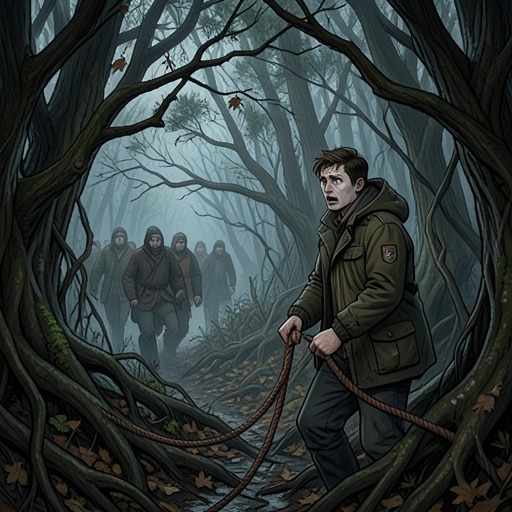
His tracking ability is repeatedly associated with exposure and pursuit. He can follow the movement of fugitives, recognize when a trail has split, and identify deliberate attempts to mislead anyone following. Yet even he is not omniscient. When the trail divides, he returns with his head lower than usual and reports uncertainty about which men entered the woods and which took another route. His expertise is valuable precisely because it operates amid incomplete signs, not because it eliminates doubt.
Eustace is also connected to the book’s suspicion of spectacle and false certainty. Jack feels that the men around him have led him toward hell with stories about what they can do, while the glitter of their claims resembles the dangerous brightness his grandfather warned him about. Eustace’s abilities are real, but the atmosphere around them can make skill look like magic or bravado. The distinction matters: Eustace is not a flawless heroic tracker but a fallible professional whose gifts must be separated from the shiny promises of men who turn violence into legend.
Family Memory and the History of Captivity
Eustace’s account of his family history extends beyond his own birth into the memory of slavery. He recounts what his grandfather Weeden told him about being sold away from his parents. His father was sold first when he was still very young, and Weeden himself was sold a few years later, perhaps at ten, though the exact age was uncertain. The uncertainty is itself meaningful: a system that treated children as property also damaged the continuity of family memory.
Weeden understood his sale through the image of a piglet torn from its mother. He had seen a man enjoy separating piglets from a sow, whipping the mother while throwing the piglet over the pen into the mud. Eustace preserves this comparison because it exposes the emotional logic of slavery: separation was not merely an economic transaction but an act of domination made pleasurable through the suffering of the vulnerable. When Jack worries that his sister may have been “weaned,” he insists that she will remember where she came from. Eustace’s inherited story gives that hope a historical foundation, even while showing how easily families can be violently severed.
The story also clarifies why Eustace’s identity cannot be understood only through his professional role. He is a worker who has been underpaid, a descendant of people owned by the Cox family, a man born from sexual violence, and a keeper of memories transmitted through damaged family lines. His kinship with Jack is both literal and morally unsettling. It makes the rescue of Lula more than an isolated act of charity: it becomes a confrontation with the older machinery that separates children, controls bodies, and converts human relationships into property.
Narrative Role and Significance
Eustace functions as a counterweight to Jack’s youth and uncertainty. Jack wants immediate action, while Eustace insists on supplies, payment, and Shorty’s agreement. That resistance does not weaken the rescue plot; it gives the quest material conditions. Tracking requires knowledge, horses, weapons, food, and endurance, and Eustace is the character who makes those requirements visible.
His relationship with Shorty also enlarges the novel’s moral vocabulary. Shorty’s small stature and Eustace’s racial identity are treated as different forms of imposed disadvantage, but neither man is reduced to victimhood. Eustace’s agricultural knowledge, tracking education, employment history, and control of violence establish a competence that the surrounding society needs even as it demeans him. His value is repeatedly recognized in practice before it is acknowledged in principle.
The character’s force is sharpened by the contrast between his self-command and his vulnerabilities. He knows how to read a landscape, yet struggles to manage money and drink. He can be protective and loyal, yet carries anger that may become destructive. He is a relative of Jack, but the family connection is born from coercion and the long history of racial hierarchy. These contradictions make Eustace a rounded figure rather than a single-function guide: his surprises arise not from arbitrary changes but from pressures already embedded in his life.
In the retrospective ending, Jack admits that the story he has told may not be perfect truth, though it is true as he remembers it. That admission places Eustace within a larger pattern of unstable memory, inherited testimony, and moral uncertainty. His life is recalled through what he did, what he suffered, what he taught, and what others feared he might become. Eustace therefore represents the novel’s central refusal of simple categories: he is worker and outlaw-like companion, family and stranger, protector and danger, victim of history and active agent within it. His presence makes the rescue narrative inseparable from the racial, economic, and psychological damage through which its characters must move.